
How It Works
In 2022, Congress authorized the transfer of certain federal tax credits to unrelated third-party buyers under IRC §6418. Qualified taxpayers may acquire eligible credits generated by approved projects and apply them directly against federal income tax liability.
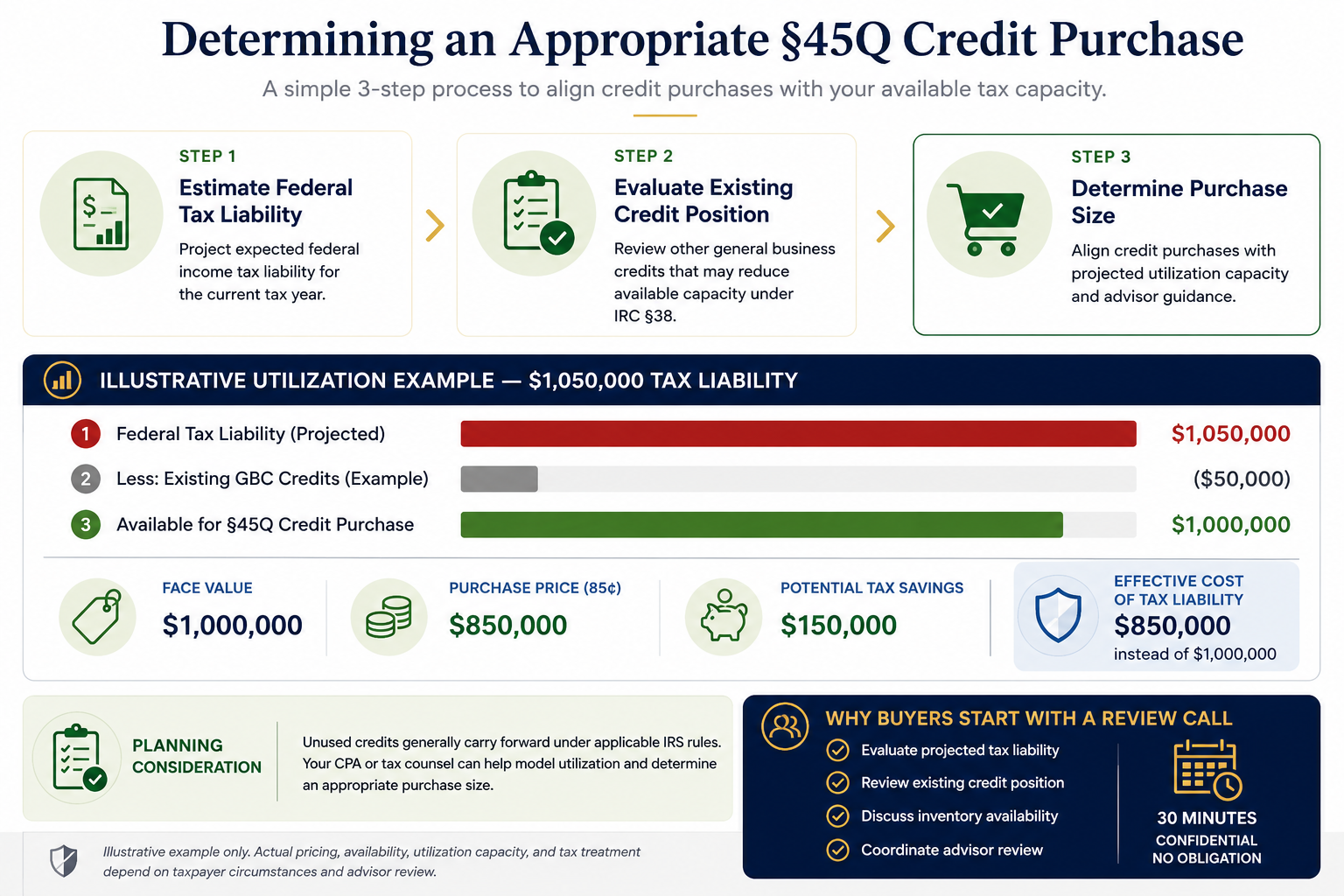
The process begins by determining how much federal tax liability is actually available for a credit purchase. Existing general business credits, carryforwards, and other tax attributes may reduce available capacity. Most buyers evaluate these factors with their CPA or tax counsel before determining an appropriate purchase size.
——————————-
For example, a taxpayer projecting $1,050,000 of federal income tax liability with $50,000 of other general business credits may have approximately $1,000,000 of remaining capacity available for a §45Q credit purchase. If $1,000,000 of eligible credits are acquired at 85 cents on the dollar, the taxpayer would pay $850,000 rather than $1,000,000 to satisfy that portion of its federal tax liability. The difference — $150,000 — remains with the taxpayer.
—————————-
This is not a deduction, a deferral strategy, or a tax shelter. It is a federally authorized transfer of a tax credit governed by the Internal Revenue Code and supported by IRS registration requirements, transfer elections, documentation standards, and established filing procedures.
A deduction reduces taxable income. A transferable tax credit reduces the tax liability itself — dollar for dollar. That distinction is why many taxpayers and their advisors evaluate transferable credits as part of a broader tax planning strategy.
Redirect Federal Tax Dollars Into Business Capital
IRC §6418 allows qualified taxpayers to acquire certain federal tax credits below face value and apply them dollar-for-dollar against federal tax liability. Redirect Tax Partners provides access to substantial §45Q inventory and coordinates the review process with your CPA and tax counsel.
Who Tends to Be a Fit
-
Typically the most straightforward profile. Corporate taxpayers generally avoid the passive activity limitations under IRC §469 that complicate individual analysis. If you're a profitable C-Corp with meaningful federal tax liability, the structure is usually straightforward to evaluate.
-
These can work, but the analysis depends on ownership structure, income type, and how the credit flows through to the ultimate taxpayer. More moving parts — still very doable with the right advisor team.
-
Real interest here, but individual-level use requires careful passive activity analysis, income characterization review, and advisor interpretation of evolving guidance. We're candid about what's clear and what's still being worked out in practice.
-
Often well-positioned, because they already have the legal, tax, and accounting infrastructure to evaluate complex structures. The diligence we deliver tends to be exactly what their existing teams expect.
The right question isn't "can I buy credits?" It's "can my advisors get comfortable with the structure?"
A serious review covers:
Taxpayer entity type and tax profile
Federal tax exposure and timing
Credit type and IRS registration
Passive activity considerations under §469
Documentation quality — lifecycle assessment, verification, legal opinion
Transfer mechanics and filing requirements (Form 3800)
Recapture analysis
Tax liability insurance options
Implementation timing
Your CPA and tax counsel run the diligence. We organize the materials, coordinate the counterparties, and answer the questions they raise. By the time they're ready to give you a recommendation, they've seen everything they need to see.
For High-Net-Worth Taxpayers Specifically
A more candid conversation.
We get a lot of inbound interest from individual taxpayers and families with significant federal tax exposure. That interest is well-placed — the underlying framework is real, and the economics can be meaningful.
But we're going to be honest with you on the first call: individual-level use of transferable credits is more complex than corporate use. The passive activity rules under §469, the characterization of credit-generated tax benefits, and the way various advisors are currently interpreting evolving guidance all matter.
For most high-net-worth situations, the cleanest path is to deploy credits inside a corporate entity within your structure — a C-Corp holding company, an operating company, or a similar vehicle — where the analysis is straightforward.
For situations where individual-level use is being considered, we'll tell you what we see in the market, what your advisors will likely want to look at, and where the open questions are. No salesmanship. Just the real picture.
What to expect on the first call.
Step 1 — We listen. Tell us your taxpayer profile, your federal tax exposure, your entity structure, your timing, and who your advisors are.
Step 2 — We give you our read. Based on what you've shared, we'll tell you whether the opportunity appears worth a deeper review, what concerns we'd want your advisors to focus on, and what a realistic timeline looks like.
Step 3 — We pause. If it's not a fit, we say so. If it is, we ask for permission to coordinate with your CPA and tax counsel.
Step 4 — We hand the diligence to your advisors. They run their review. We support them. You stay focused on your business.